
🎬
Visually rich
Real CMR cines, illustrations and console planning videos, with the reference lines in motion.
BetaThe course is in testing. Official access opens soon. Sign up to get your access →
Online course · INCIC
Topography, ventricular function, coronary anatomy, infarction and late enhancement, protocols and planning in cardiac MR
An interactive, visually rich course for radiographers and physicians, useful at every level. It starts from the basics and builds step by step: each lesson explains with real cines and illustrations, asks and unlocks the next one.
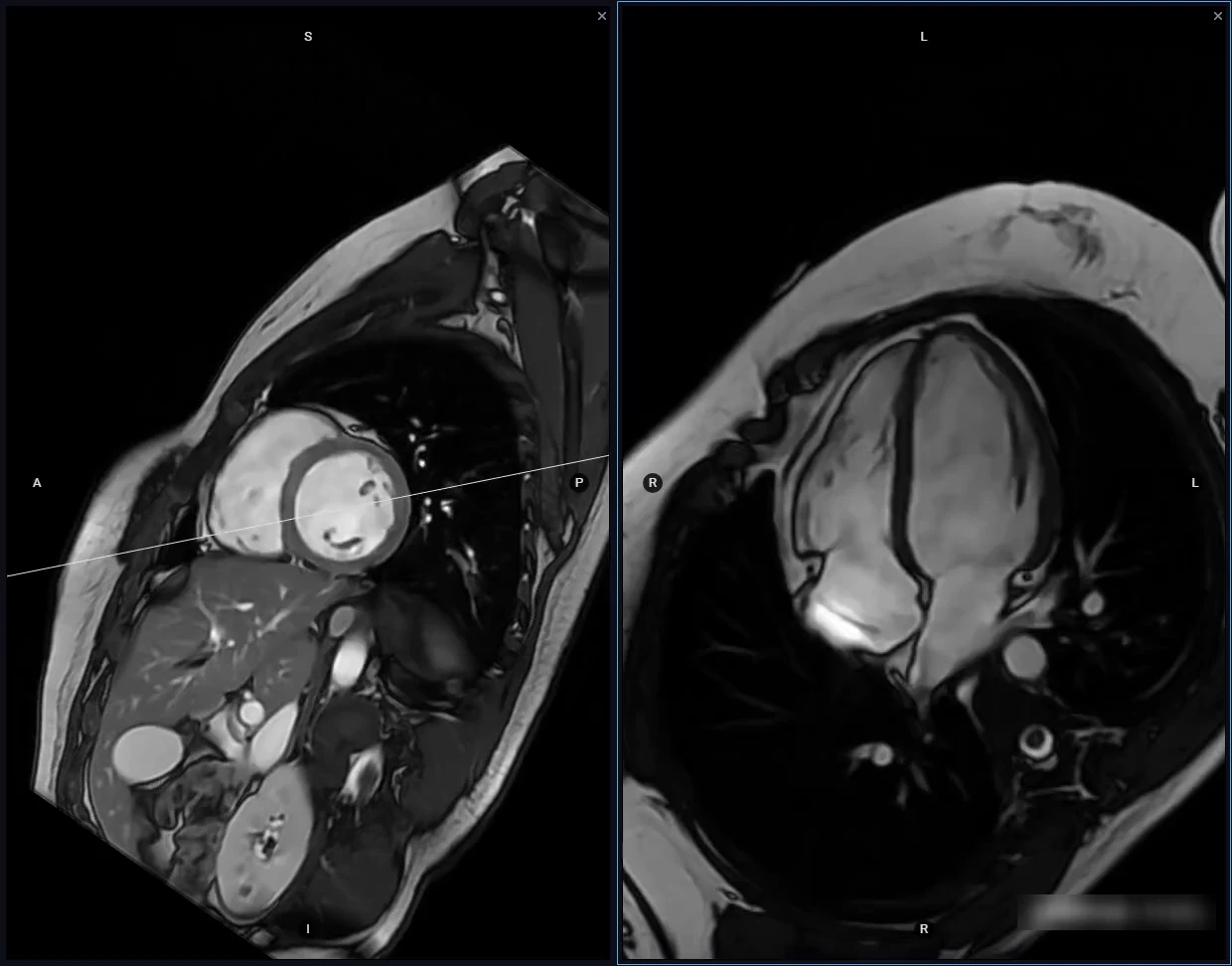
The course has two sections. “Essential knowledge” teaches you to find your way around the heart and its views, assess global and regional function and wall thickness, and recognise coronary anatomy, infarct patterns and late enhancement. “Planning” covers the protocols and sequences of a scan and how to plan the views, with a simulator and calculators for daily practice.
Lessons combine illustrations, real cines and quick questions. Left ventricular axes ends with a game where you tap the walls each axis cuts, and the CMR simulator lets you plan the 3C, 4C and 2C in two steps.
Radiographers and physicians at every level. Newcomers to cardiac MR find the essentials explained from scratch, and experienced readers can review and go deeper with “Go deeper” on every topic. Questions only cover what the course has already explained.
🎬
Real CMR cines, illustrations and console planning videos, with the reference lines in motion.
🧩
Quick questions in every lesson, a game where you tap the walls each axis cuts and a simulator to plan the 3C, 4C and 2C.
📈
Each topic has key points, mistakes to avoid and optional extra theory: useful to start and to go deeper.
📚
INCIC teaching material and international SCMR, AHA and ESC guidelines, cited in the course.
Instructors
 Bruno Dighero EberhardINCIC CMR fellow
Cardiac anatomy and views, ventricular function, wall thickness, coronary anatomy, infarct patterns and late enhancement.
How the heart sits in the chest, what the cardiac axes are, and how the LV walls and 17 segments are named.
≈ 21 min · 8 topics · 2 videos · 10 questions
Which walls and segments each LV long axis (4C, 3C and 2C) cuts, and how to spot a misaligned plane.
≈ 18 min · 6 topics · 3 videos · 6 questions
The long axes of the right heart: RV 2C and 3C and the RV outflow tract, how to plan them and how they look on cine.
≈ 22 min · 8 topics · 13 videos · 11 questions
Ejection fraction, volumes, how to contour and how to check that the numbers make sense.
≈ 17 min · 6 topics · 3 videos · 9 questions
Wall motion: normokinesia, hypokinesia, akinesia and dyskinesia, how they relate to LGE, and pseudodyskinesia.
≈ 17 min · 6 topics · 7 videos · 10 questions
Why LV wall thickness matters, its causes and thresholds, how to measure it well and which patterns and pitfalls to look for.
≈ 26 min · 9 topics · 16 questions
The coronary arteries and their branches, dominance, why the lesion level does not always match the infarct level, and coronary plaque.
≈ 17 min · 6 topics · 10 questions
Which segments an infarct involves depending on the artery and the level of occlusion: proximal, mid and distal LAD, the PDA and dominance, and how to tell the RCA from the Cx, with cine and LGE cases.
≈ 26 min · 9 topics · 16 questions
Replacement and interstitial fibrosis, ischaemic and non-ischaemic late enhancement and its patterns, LGE mimics and quantification.
≈ 33 min · 11 topics · 22 questions

Protocols and sequences, localisers and view planning, the simulator and the calculators.
How a CMR protocol is built around the clinical question, what each sequence is for, what it looks like and what it is called on Siemens, GE, Philips and Canon.
≈ 23 min · 8 topics · 1 video · 14 questions
From localisers and pilots to the final LV axes: the two-reference recipe for the 3C, 4C and 2C, the LV outflow tract and the full short-axis stack.
≈ 31 min · 12 topics · 11 videos · 14 questions
Practise the two-reference recipe: plan the 3C, 4C and 2C in the simulator and earn a medal for the accuracy of each plane.
≈ 10 min
 Lesson 13Calculators
Practise with four everyday CMR calculators: gadolinium dose by weight and kidney function, adenosine infusion, extracellular volume (ECV) and indexed ventricular volumes.
≈ 15 min · 5 topics · 9 questions
🆓
Start now, no sign-up needed.
🔑
The rest of the course unlocks with a code from INCIC. It arrives by email with a link that activates it in one click.
🏅
Each lesson ends with questions, earns points and awards a badge. Your progress is saved in your browser.
🎓
On passing the course final exam (coming soon).
Beta
Leave your details and we will email you your access link and code as soon as the course is open.
Visit and ad measurement
With your permission we use Google Analytics and Google Ads to count visits to the site and find out whether our ads bring enquiries. We do not personalise ads or send your form data to Google. Learn more